

Requirements for AI Systems: How a Well-Designed Process Model Leads Projects to Success
For years, Spirit in Projects has supported companies and public sector clients in designing, tendering, and implementing AI systems. One thing has been consistently confirmed: A structured, data-driven, and value-oriented process model is the key to success—regardless of whether the project follows V-Modell XT, Scrum, or a custom hybrid approach.
Many AI projects fail not because of the technology, but due to a lack of methodological rigor in gathering and implementing requirements.
From Gut Feeling to Structured Requirements
In traditional projects, specifications with clear functionalities often suffice—but AI systems require a different mindset. Key questions include:
- What is the AI’s actual objective?
- What data is truly available?
- How precise must the model be to deliver real value?
We use an internal methodological framework inspired by CRISP-DM, adapted for modern AI projects with needs like MLOps, retraining, and continuous improvement. This model structures our workshops and stakeholder interviews—from Business Understanding to Data Understanding to concrete evaluation criteria for AI models.
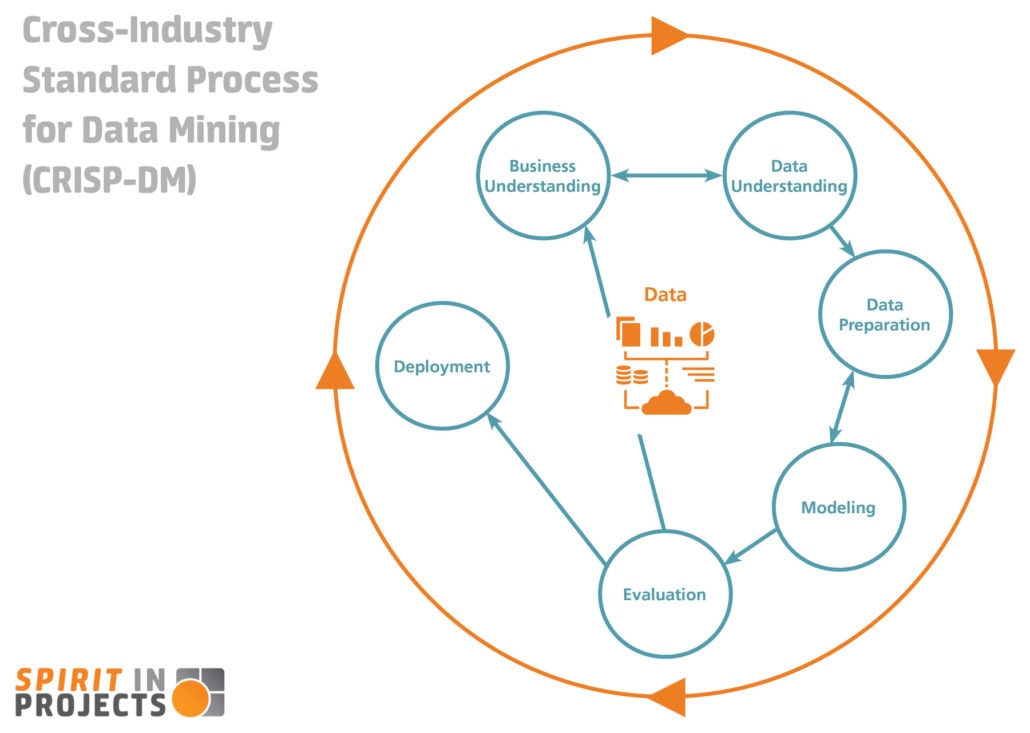
A Planned Approach—Even in Agile or Classical Contexts
Our clients work with different methodologies: some use Scrum, others the V-Modell XT. For AI projects, however, we recommend adding an AI-specific structure. We integrate our CRISP-DM-based logic into the existing framework:
- In agile projects, it brings order to exploratory data work.
- In classical environments (e.g., public tenders), it serves as a blueprint for AI-specific requirements.
The key is: We create a common language between business units, data scientists, and IT—ensuring requirements are not just documented but understood and verifiable later.
Requirements Need Iteration—and Data
Another guiding principle: AI requirements don’t emerge from a blank sheet but through iteration, discussion, and what the data reveals. An ideal process model accounts for this:
- Data exploration often leads to new insights that reshape requirements.
- Model testing shows whether target accuracy is realistic—or if adjustments are needed.
- Feedback loops with stakeholders are not a nuisance but a valuable asset.
In our projects, we deliberately plan for these iterations—not as exceptions, but as the norm. This improves both result quality and user acceptance during deployment.
Conclusion: Structure Provides Security
An AI project without a structured approach is like a flight without a flight plan—you rarely end up where you intended. With a well-designed, AI-tailored process model, we help our clients gain early clarity, define realistic requirements, and create reliable tenders.