

• Link to Xing
  • Link to LinkedIn
  • English English English en
  • Deutsch Deutsch German de
AT: +43 1 714 00 20 | DE: +49 69 348763610 | Mo-Fr 8am-5pm
Spirit in Projects
  • Training / ACADEMY
  • Blog
  • Innovation
  • Certifications
  • Consulting
  • About us
  • German
  • Click to open the search input field Click to open the search input field Search
  • Menu Menu
Veränderungsmotor Technologie: KI-Einsatz im Software-Engineering

Technology as an engine of change: AI tools in software engineering and their impact

6. May 2024

Technological progress often proves to be an engine which drives change in the ways we work and our organizational structures. In two consecutive articles we take a look at possible repercussions of AI on the software industry. In this first part we look at new tools and forms of work that result from innovations in the field of AI. The second part of the series then deals with effects on organization and collaboration.

Digital transformation is advancing at rapid tempo, bringing with it the need to optimize software development and make it more efficient. One key technology in this regard is artificial intelligence (AI), which is impacting not only the ways we work and our organizational structures, but even our corporate cultures.
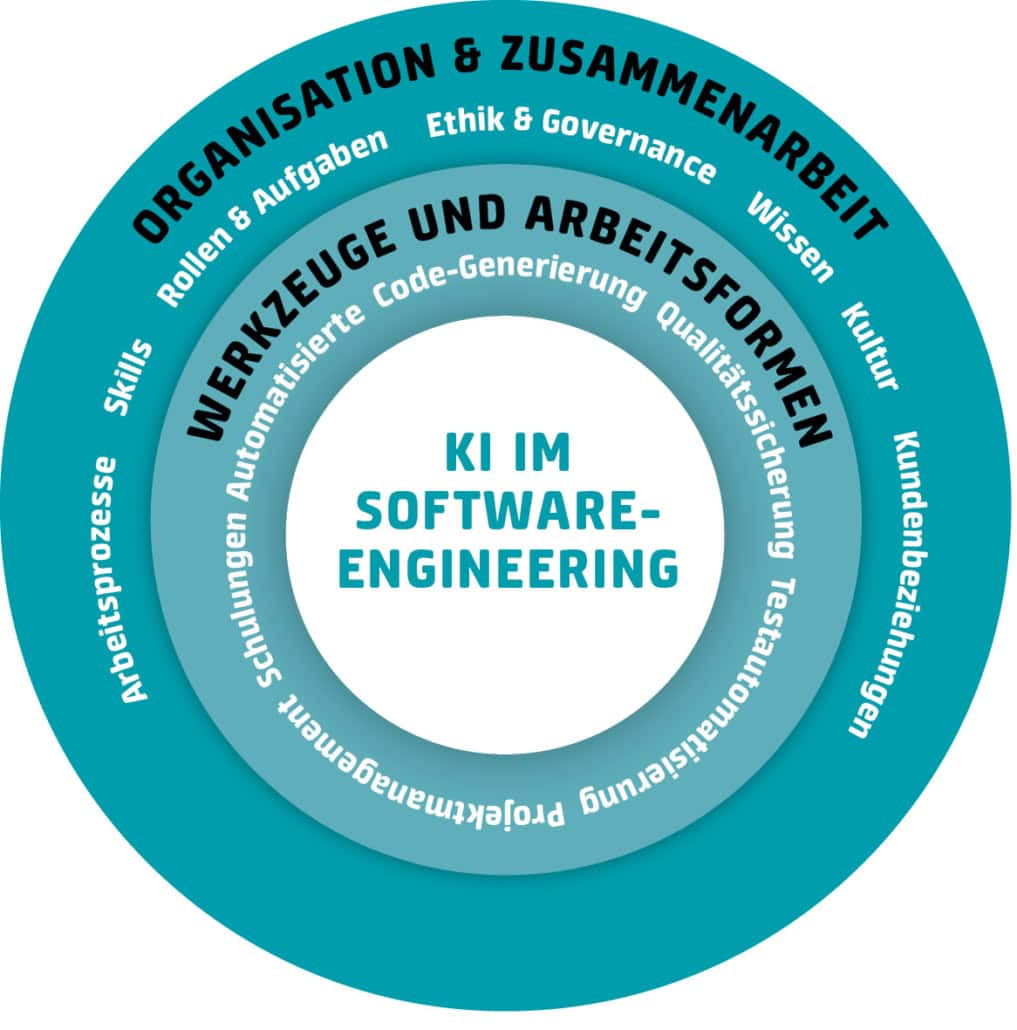
The use of AI in software engineering impacts tools and ways of working as well as organization and collaboration.

Below we provide an overview of what we believe to be the most relevant AI-driven tools and their impact on the industry.

Automatic code generation

Imagine that instead of typing in code line by line, you just formulate your requirements in a natural language, then an AI application generates the corresponding code. Models like OpenAI’s GPT-4 already have the ability to carry out basic programming tasks on the basis of natural language queries. This can significantly reduce development time and also improve code quality.

Code review and quality assurance

All developers are aware of the challenges which come with code reviews. AI systems have the ability to continuously review code, identify potential errors and recommend best practices, thus enhancing human review processes and contributing to error reduction.

Optimization and test automation

Not only can AI help humans to write code which is more efficient, it can also automate tests. Instead of creating test scenarios manually, AI models which are based on existing code can automatically generate and execute test cases.

Effective project management

One of the greatest challenges in software engineering is resource allocation. How long will it take to develop a feature? What resources will it require? By analyzing historical data, AI can make more accurate predictions of development times and can optimize resource allocation.

Personalized training

AI can identify specific training needs and recommend customized learning paths for each developer on a team, making it possible to continuously improve the entire team’s quality and effectiveness.

The use of AI in software development is fundamentally changing the ways people work together and the kinds of roles they take on at companies.

Karl Schott, Gründer & CEO

In the second part of the article, we examine what impact these tools have on organization and collaboration in software engineering.

Share this entry
  • Share on Facebook
  • Share on X
  • Share on WhatsApp
  • Share on Pinterest
  • Share on LinkedIn
  • Share on Tumblr
  • Share on Vk
  • Share on Reddit
  • Share by Mail
https://spiritinprojects.com/wp-content/uploads/2024/05/sip_blog_ki_technolgiewandel.jpg 450 900 Karl Schott https://spiritinprojects.com/wp-content/uploads/2020/04/sip_web_padding_10px_topbot.jpg Karl Schott2024-05-06 21:17:532024-05-21 21:43:24Technology as an engine of change: AI tools in software engineering and their impact

About the author:

CEO von Spirit in Projects - Karl Schott
Karl Schott

Karl Schott ist CEO von Spirit in Projects. Er befasst sich intensiv mit Digitalisierung, neuen Technologien und digitaler Transformation.

Recent
  • The True Costs of Poor Requirements22. June 2026 - 14:57
  • The 10 Most Common Mistakes in IT Tenders – and Why Many...18. June 2026 - 9:30
  • Agentic AI: Why AI Systems Can Now Act Autonomously –...21. May 2026 - 13:41
  • When AI safety mechanisms fail—and what helps to prevent...5. May 2026 - 15:44
Tags
Agile Agile methods Agile methods and Kanban AI Artificial Intelligence AWS Business Analysis City of Vienna Cloud Demand Management Design Thinking Digitalization Document Analysis Efficient Software Development Enterprise Architecture Eurotax Innovation Invitations to tender ITG KABEG Kanban modeling Organizational Development Organizational Strategy Portfolio Management Process Management Program Management Project Controlling Project Management Project Marketing Projektmanagement Quality Management Requirements Engineering Software Architecture Stakeholder Management System Architecture Test Management Training UML UML Modelling Usability User Experience VIA Videotraining ÖBB

Contact us!

Order information material via email.
  • Mail
  • Xing
  • Linkedin
© Copyright - Spirit in Projects - Enabling digital innovation
  • Terms of Service
  • Imprint
  • Privacy policy
  • Contact
Scroll to top Scroll to top Scroll to top

Our website only uses technical necessary cookies. We do not use third party services.

Close

Cookie and Privacy Settings


How we use cookies

We may request cookies to be set on your device. We use cookies to let us know when you visit our websites, how you interact with us, to enrich your user experience, and to customize your relationship with our website.

Click on the different category headings to find out more. You can also change some of your preferences. Note that blocking some types of cookies may impact your experience on our websites and the services we are able to offer.

Essential Website Cookies

These cookies are strictly necessary to provide you with services available through our website and to use some of its features.

Because these cookies are strictly necessary to deliver the website, refusing them will have impact how our site functions. You always can block or delete cookies by changing your browser settings and force blocking all cookies on this website. But this will always prompt you to accept/refuse cookies when revisiting our site.

We fully respect if you want to refuse cookies but to avoid asking you again and again kindly allow us to store a cookie for that. You are free to opt out any time or opt in for other cookies to get a better experience. If you refuse cookies we will remove all set cookies in our domain.

We provide you with a list of stored cookies on your computer in our domain so you can check what we stored. Due to security reasons we are not able to show or modify cookies from other domains. You can check these in your browser security settings.

Other external services

We also use different external services like Google Webfonts, Google Maps, and external Video providers. Since these providers may collect personal data like your IP address we allow you to block them here. Please be aware that this might heavily reduce the functionality and appearance of our site. Changes will take effect once you reload the page.

Google Webfont Settings:

Google Map Settings:

Google reCaptcha Settings:

Vimeo and Youtube video embeds:

Privacy Policy

You can read about our cookies and privacy settings in detail on our Privacy Policy Page.

Privacy policy
Accept basic settingsAccept all cookiesClose notification