

Fewer Projects? Now Is the Best Time for Professional Development.An Unexpected Opportunity
Many companies are currently experiencing a phase that would have been hard to imagine just a few years ago. IT projects are being postponed, investments are being reassessed, and budgets are being allocated more cautiously. Especially in economically uncertain times, many organizations focus on day-to-day operations and temporarily shelve larger initiatives.
At first glance, this development seems to have only downsides. Fewer projects mean less change, less innovation, and often lower employee utilization. But if you take a closer look, an opportunity emerges—one that many companies fail to seize.
Because when project pressure eases, space opens up for something that often gets short shrift in the hectic world of project work: targeted skill-building.
The Challenges Remain
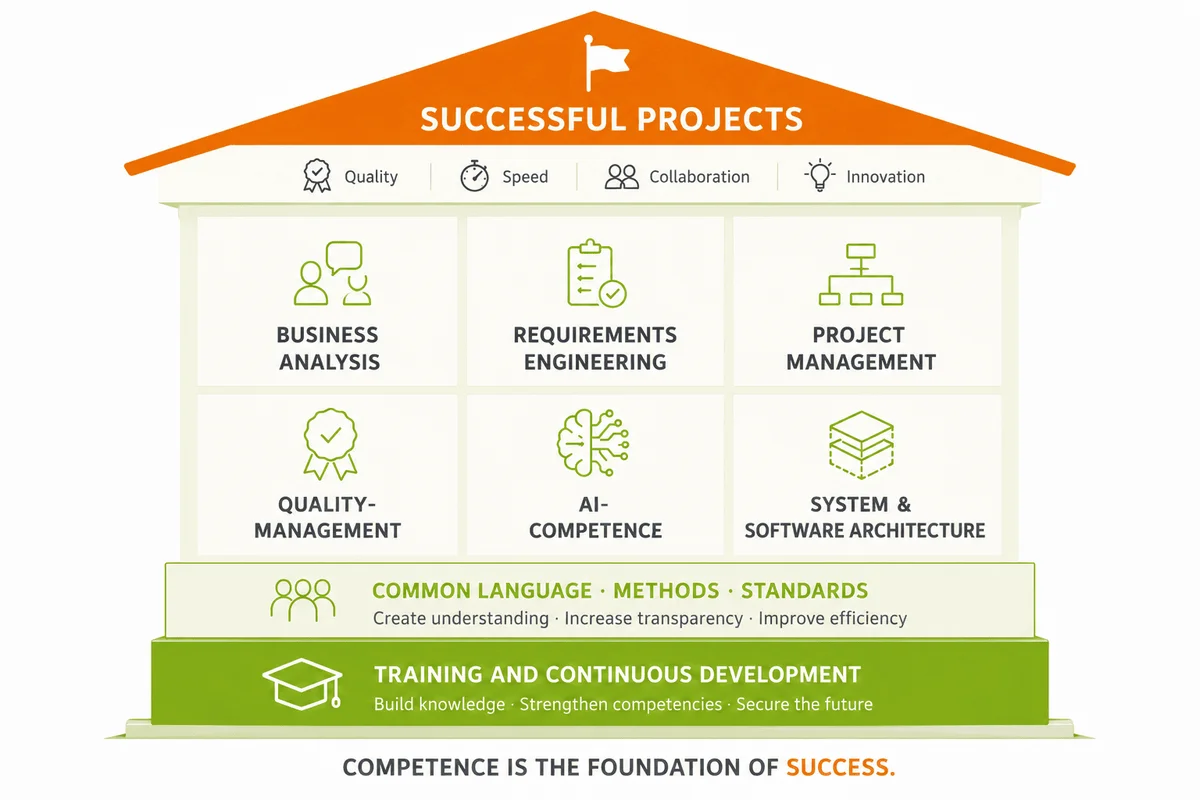
In many organizations, the challenges are already well-known. Product owners take on additional responsibilities beyond their core roles. Requirements are documented by different teams using varying standards. Business analysts develop their own approaches, and project team members often learn new methods only mid-project. At the same time, interest in artificial intelligence is growing—without shared guidelines or sufficient expertise.
These problems don’t disappear just because projects are delayed. They’re merely deferred, only to resurface more prominently when the next project begins.
From our experience, the biggest project risks rarely stem from missing technology. Far more often, they arise from inconsistent work methods, unclear requirements, or a lack of shared understanding—leading to delays, misunderstandings, and costly rework. That’s why professional development is far more than just a personnel development measure. It’s an investment in the organization’s overall performance.
Why Now Is the Right Time
During an active project, finding time for training is often difficult. Every day spent in a workshop feels like a lost project day. Schedules are tight, milestones must be met, and priorities naturally focus on delivery.
In quieter phases, this perspective shifts fundamentally. The opportunity cost of training is significantly lower, while there’s ample time to learn new methods, discuss them, and embed them across the organization.
Companies can use this time to prepare employees for their roles, professionalize requirements engineering, or establish a shared understanding of business processes and their modeling. Building competencies in artificial intelligence is also becoming increasingly important. Those who explore AI’s possibilities and limitations today will be far better equipped to apply these technologies meaningfully in projects tomorrow.
Adults Learn Differently
Another often-overlooked advantage of quieter project phases is this: Adults learn most effectively when they have time to reflect on new content and gradually integrate it into their daily work.
Learning psychology shows that sustainable learning succeeds best when new content is reflected upon, discussed, and then immediately applied in practice. Quieter project phases provide exactly this kind of space.
Under time pressure, training is often seen as a necessary interruption to the project. The knowledge gained quickly fades into the background amid the daily grind. But when there’s enough time for exercises, discussions, and peer exchange, a shared understanding and new work methods emerge—ones that become deeply embedded in the company. This is how common standards and a unified project culture develop.
The Benefits Become Clear in the Next Project
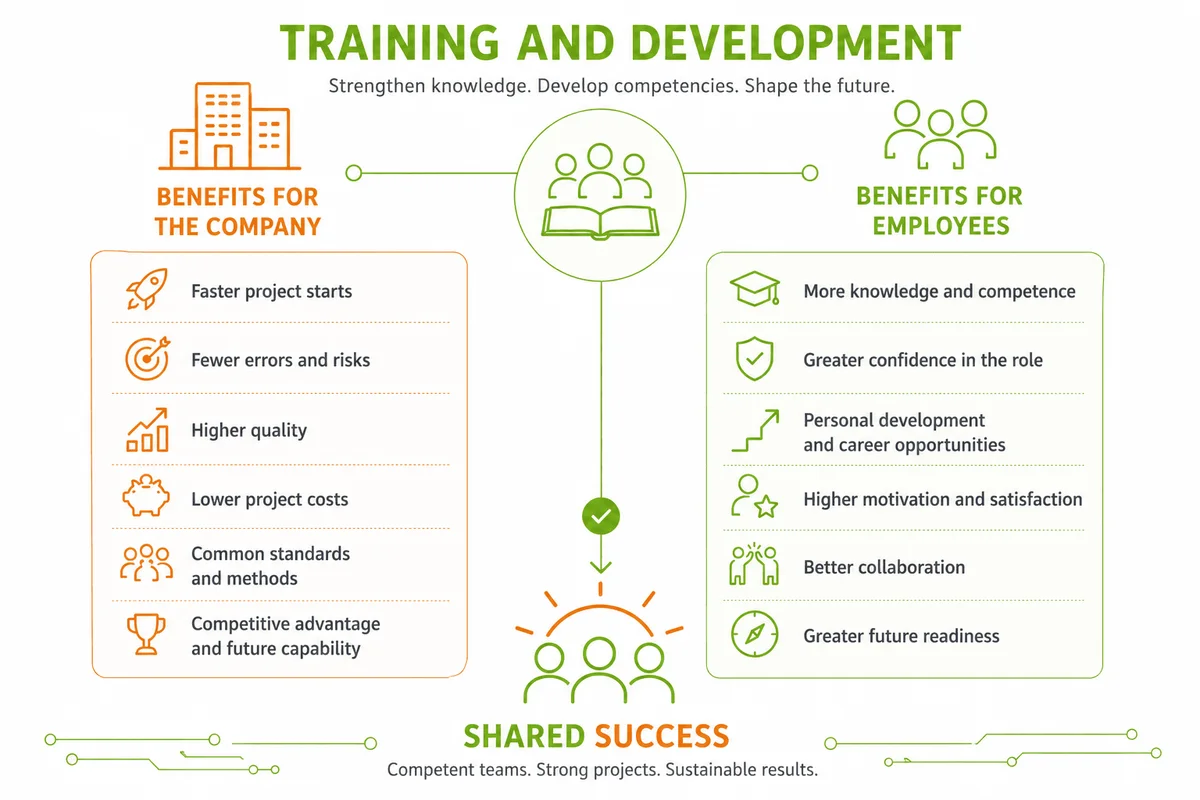
The real benefits, however, only become apparent later. Well-trained teams start projects more structured, make better-informed decisions, and speak a common language. Requirements are gathered more thoroughly, misunderstandings are caught early, and changes are implemented more controlled. This doesn’t just reduce coordination efforts—it also improves result quality and shortens the ramp-up phase for new projects.
Many successful companies deliberately invest in employee development during economically challenging times. They know project budgets aren’t frozen forever. Sooner or later, new initiatives will launch. Then, success won’t depend solely on budget size but on how well the organization is prepared.
The Advantage Is Created Today
Those who view the current phase as mere waiting time will face the same challenges at the next project start as before. But those who use this time to build skills, establish shared standards, and develop employees strategically gain a sustainable competitive edge. Projects don’t just start faster—they often run more efficiently and with significantly higher result quality.
Requirements engineering repeatedly shows that a project’s success hinges on the quality of its requirements. And good requirements don’t happen by chance. They result from solid training, a shared methodology, and sufficient practical experience. The same applies to business analysis, process management, project management, or the professional use of artificial intelligence. Competence isn’t built during the project—ideally, it’s developed beforehand.
Conclusion
The current market situation may be challenging for many companies. At the same time, it offers an opportunity rarely available in the frenetic world of project work. Investing today in your employees’ knowledge and skills lays the foundation for tomorrow’s project success.
When investments pick up again and new projects begin, it won’t matter who starts first. What will matter is who is best prepared.
Competence is one of the few competitive advantages that economic fluctuations can’t devalue—in fact, it gains even more importance in challenging times.